
Job Titles Are Becoming Worse Predictors of Who Can Do the Work

A job title is useful shorthand. It gives employers and candidates a quick way to name a broad area of work. It is much less useful as proof that someone can perform the job in front of them.
That gap is getting wider. Roles are accumulating responsibilities, technical skills are spreading into work that was previously described as non-technical, and familiar occupations are changing faster than their labels. The practical result is simple: two people with the same title may now have very different capabilities, while someone with a different title may already know how to solve the problems a role contains.
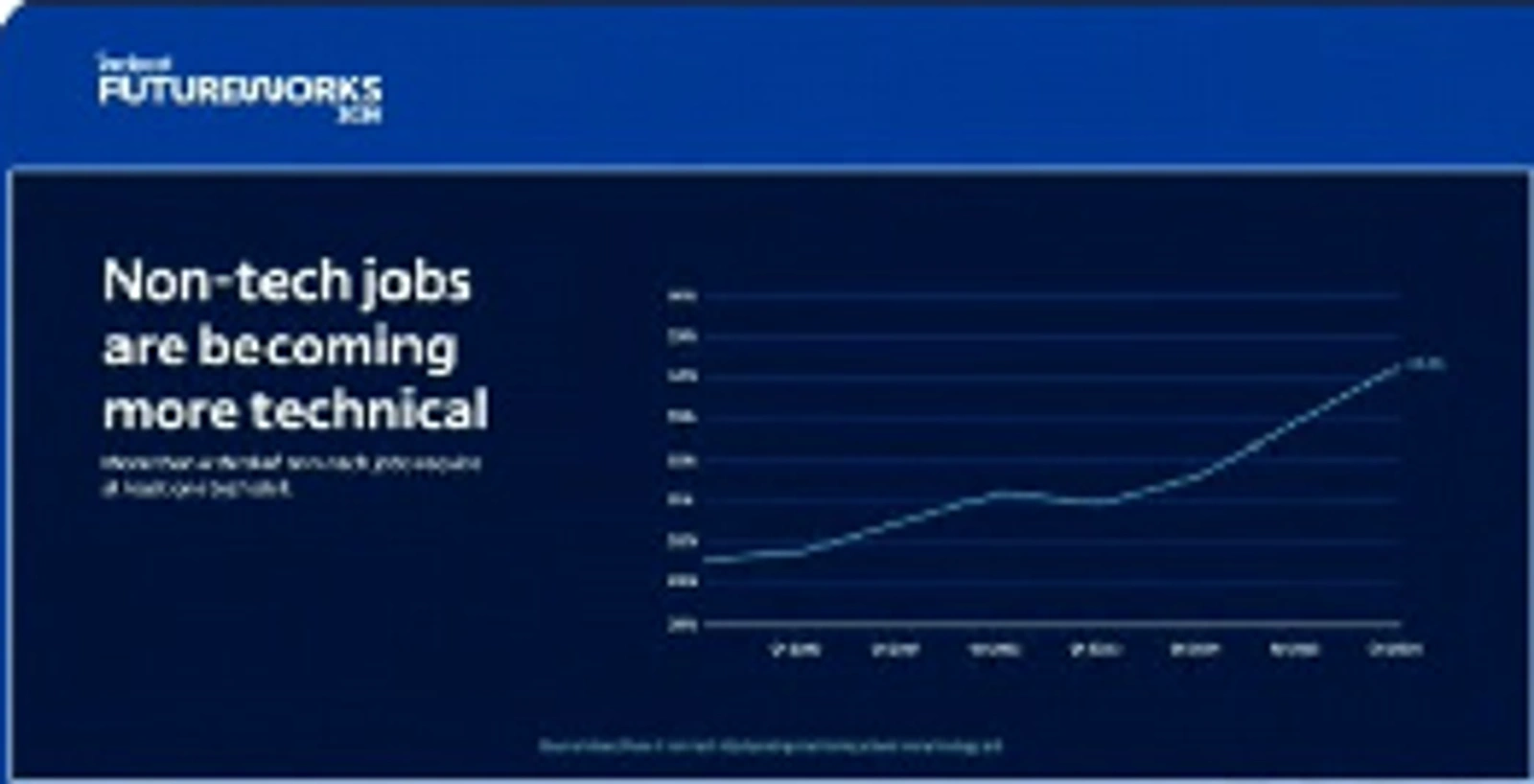
At Indeed FutureWorks 2026, Indeed Chief Economist Dr. Svenja Gudell gave this change a measurable shape. The average job posting now asks for two more skills than it did before the pandemic, she said. At the same time, the share of non-technical jobs requesting at least one technical skill has steadily increased.
Those two trends do more than make job descriptions longer. They weaken the assumptions employers and candidates attach to job titles.
A familiar label can conceal a changing job
Titles tend to move slowly because organizations need stable categories for pay bands, reporting structures, labor-market data, and career paths. The work inside those categories is less stable.
A recruiter may now need to evaluate AI-supported sourcing tools and understand how automated screening affects candidates. A marketing manager may need to interpret analytics, work inside automation platforms, and identify when a generated output is unreliable. An operations role may depend on systems knowledge that would once have belonged to an IT team.
None of these people necessarily needs to become a software engineer. Technical capability can mean knowing how a system reaches a conclusion, where its limits are, and when human judgment needs to interrupt it. That is part of the “technification of jobs” Gudell described.
The title may remain unchanged while the mix of tasks, tools, and decisions underneath it shifts substantially. Hiring from the title alone assumes yesterday’s label still describes today’s work.
Source: Dr. Svenja Gudell, “A New Era of Work,” Indeed FutureWorks 2026.
More requirements can make matching less accurate
Employers often respond to a changing role by adding requirements. Each new tool, responsibility, and preferred background goes into the posting. This can feel rigorous because the description becomes more specific.
It can also make the search less precise. A long list often mixes three different things: capabilities required on the first day, skills a strong candidate could learn, and preferences inherited from the person who previously did the job. When all three are treated as mandatory, an employer can narrow the talent pool without improving the eventual match.
The problem is especially visible when a title becomes a proxy for the whole list. A candidate who has held the title may know its language without having worked under comparable conditions. Another candidate may have a different title but strong evidence of solving similar problems, learning similar systems, or working effectively with the same kinds of people.
Indeed’s recent Skills Map research reflects the scale of the challenge. The project analyzed thousands of individual skills across millions of postings to understand which ones travel together. That level of detail is necessary because broad occupational categories alone cannot show how actual capabilities overlap.
Technology makes adaptability part of the job
There is a second reason to look beneath the title. Some of the tools named in a posting will change faster than the person’s career.
Indeed’s AI at Work report analyzed tens of millions of postings at the level of skills and tasks. Its approach matters: technology rarely transforms every part of an occupation at once. It changes particular tasks, which then alters what people need to know and where their judgment adds value.
A candidate’s experience with one platform may be useful today. Their ability to learn unfamiliar systems, test an output against context, communicate with the people affected, and adapt a process when conditions change will travel further.
That does not make specific expertise unimportant. It changes the question from “Has this person already used every tool on our list?” to “What evidence shows that this person can learn and apply the capabilities this work requires?”
Hiring needs to look beneath the title
Longer job descriptions will not make titles disappear. Employers and candidates still need a shared language for describing occupations. The problem begins when that language is treated as proof of ability.
For employers, a more useful job description separates three categories: capabilities someone must bring on the first day, skills a strong candidate can learn, and preferences inherited from how the role was previously performed. Without that distinction, every new requirement reduces the apparent talent pool without necessarily improving the eventual hire.
The same distinction matters when candidates are evaluated. Someone who has already held the title may understand the vocabulary of the role while struggling with its actual conditions. Another candidate may come from a different occupation but have strong evidence of solving similar problems, learning comparable systems, or working effectively with the same kinds of people.
Candidates also need a more precise way to present their experience. A previous title provides context, but the stronger evidence lies underneath it: the decisions they owned, the problems they repeatedly solved, the systems they learned, and the environments in which they did their best work.
This becomes increasingly important as technology changes the contents of a role. A platform named in today’s posting may be replaced within a few years. The ability to learn unfamiliar systems, recognize faulty outputs, understand the people affected by a decision, and apply knowledge under real conditions will travel further.
The average job posting now asks for two additional skills, and technical requirements are reaching further into non-technical work. Hiring practices built around familiar labels will overlook some of the people most capable of adapting to that change.
A title can start the conversation. A good hiring decision requires a clearer view of the person, the work, and the conditions in which the two are likely to fit.

Guy Giguère, creator of the RVEAL framework and cofounder of RVEAL, has four decades of coaching across North America, Europe, and Africa, 100+ talks on labor-market evolution,…
Ready to find career alignment?
Take the assessment and get 3 free coaching sessions with Leo.