
AI Cost Cutting Can Remove the Managers a Company Will Need Later

An entry-level position is both a job and a stage in a development system. When AI removes the job, it can remove that stage too.
This makes some automation decisions more consequential than their business cases suggest. A task may be inexpensive to automate and still be one of the places where people learn how the organization works, make low-risk mistakes, and develop the judgment required for larger decisions.
At Indeed FutureWorks 2026, speakers in the “Culture Casting” session shared two figures that expose the tension. Entry-level positions account for 56 percent of roles leaders expect AI to eliminate first. At the same time, 82 percent of leaders acknowledge that failing to develop people now will leave them without capable managers later.
Companies can agree with both statements and still make decisions as though only the first one matters.
The first rung does more than produce output
Junior work often contains repetitive tasks, which makes it a natural target for automation. Repetition also creates exposure.
A new analyst sees how good and bad inputs change a conclusion. A coordinator learns which stakeholders need to be involved before a decision is announced. A recruiter begins to recognize the difference between an unusual background and a weak one. Over time, these encounters become pattern recognition and practical judgment.
The role also lets an organization observe the person. Managers see how someone handles feedback, ambiguity, competing priorities, and mistakes. That evidence informs who receives more responsibility.
Removing routine output does not automatically preserve either form of learning. A junior employee may use AI to produce more sophisticated work while understanding less of the path that created it. A company may also hire fewer junior people, leaving a smaller group from which to develop future managers and experts.
The savings and the risk run on different timelines
Automation savings are visible quickly. Fewer hours are required, a team handles more volume, or a vacant role is not replaced. Pipeline damage appears later.
It may surface when a manager leaves and no internal candidate has enough experience. The company then competes for scarce external talent, pays a premium, and asks a newcomer to lead without the organization's accumulated context. By that point, the missing years of development cannot be restored quickly.
This time lag makes the risk easy to discount. The department that captures today's efficiency may not carry the full cost of tomorrow's succession gap.
The role-cut breakdown presented at FutureWorks draws on the 2026 Milken Institute-Harris Poll Listening Project. Its underlying message is broader than entry-level hiring: organizations are reducing positions at the exact levels where professional judgment is usually built.
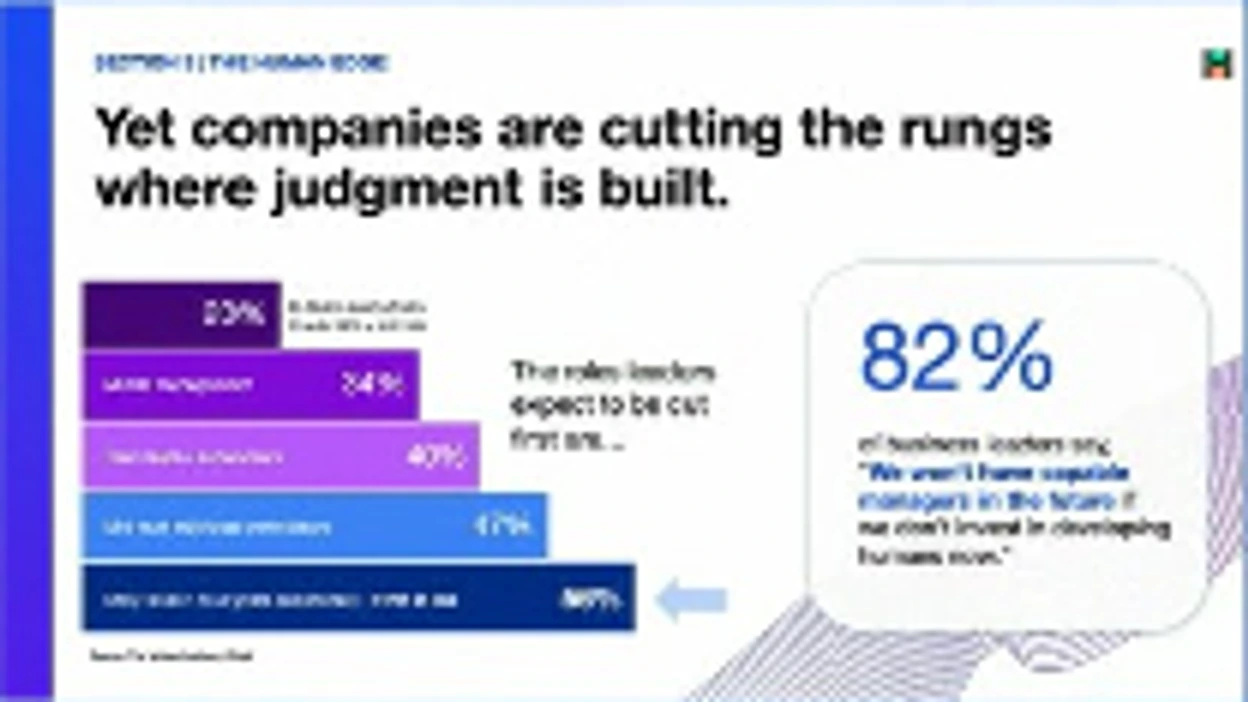
Source: “Culture Casting: The Human Edge in the Peak Bot Era”, Indeed FutureWorks 2026. The role-cut breakdown draws on the March 2026 Milken Institute-Harris Poll Listening Project.
Development has to become an explicit operating choice
Preserving every old task is not the answer. Work that can be automated safely should not remain manual merely to create hardship for junior employees.
The better response is to identify what the task taught and rebuild that learning deliberately. AI-assisted work can include source checking, comparison of alternative outputs, explanation of reasoning, and review with an experienced colleague. Rotations and simulations can expose employees to cases that automation makes less common. Bounded decisions can give them real accountability without placing the organization at unacceptable risk.
Managers also need to know whether an employee understands the work or can only produce a polished result. Reviewing the final deliverable is no longer enough. Development conversations need to examine assumptions, trade-offs, rejected options, and the point at which human judgment changed the machine's recommendation.
So what belongs in an AI workforce plan?
Every automation proposal should include a development impact alongside its cost and productivity estimates. Which roles feed the next level? What experience do people gain there? How many future managers or specialists are likely to be needed? Where will those capabilities come from if the role shrinks?
The answers may lead to smaller junior cohorts rather than no cohorts, redesigned apprenticeships, stronger internal mobility, or explicit technical and management pathways. They may also justify retaining certain tasks because the cost of losing the learning environment is higher than the immediate saving.
For current managers, the practical responsibility is to make hidden learning visible. Name the judgment embedded in routine work. Give junior employees opportunities to explain and challenge AI outputs. Track progression in decision quality, not only output volume.
AI can remove tasks without removing a career ladder, but only when the ladder is redesigned on purpose. Otherwise, a company may achieve a leaner organization today and discover later that it has also automated away the people who were supposed to lead it.

Guy Giguère, creator of the RVEAL framework and cofounder of RVEAL, has four decades of coaching across North America, Europe, and Africa, 100+ talks on labor-market evolution,…
Ready to find career alignment?
Take the assessment and get 3 free coaching sessions with Leo.