
When AI Removes Entry-Level Work, It Also Removes the Training Ground

Many entry-level tasks are attractive targets for AI because they are repetitive, structured, and relatively easy to check. Automating them can reduce cost and free experienced employees from routine work.
It can also remove the environment in which inexperienced people become experienced.
Junior work has never been valuable only for its immediate output. It lets people observe how an organization makes decisions, practice on lower-risk problems, receive correction, and accumulate the context required for harder assignments. If an employer automates the bottom of a career ladder without rebuilding that learning process, the short-term efficiency gain can create a long-term shortage of capable senior talent.
Harvard Business School professor Joseph Fuller described this pressure during The Hiring Shift at Indeed FutureWorks 2026. Industries highly exposed to AI had seen a 20 percent reduction in entry-level postings, he said, and current tools could make roughly 12 percent of entry-level jobs uneconomical. His larger concern was the pipeline: where will future experts and leaders come from if the work that once trained them disappears?
Routine work often carries hidden lessons
An entry-level analyst who cleans data begins to notice which errors recur and how they affect conclusions. A junior recruiter who reviews applications learns the many ways relevant experience can be described. A new consultant preparing first drafts sees how a client’s stated problem differs from the real one.
The task may look mechanical from above. Repeated exposure builds pattern recognition underneath it.
That does not justify preserving drudgery for its own sake. Much junior work is tedious, poorly supported, and only loosely connected to development. The important question is which learning the task provided and how that learning will happen after the task is automated.
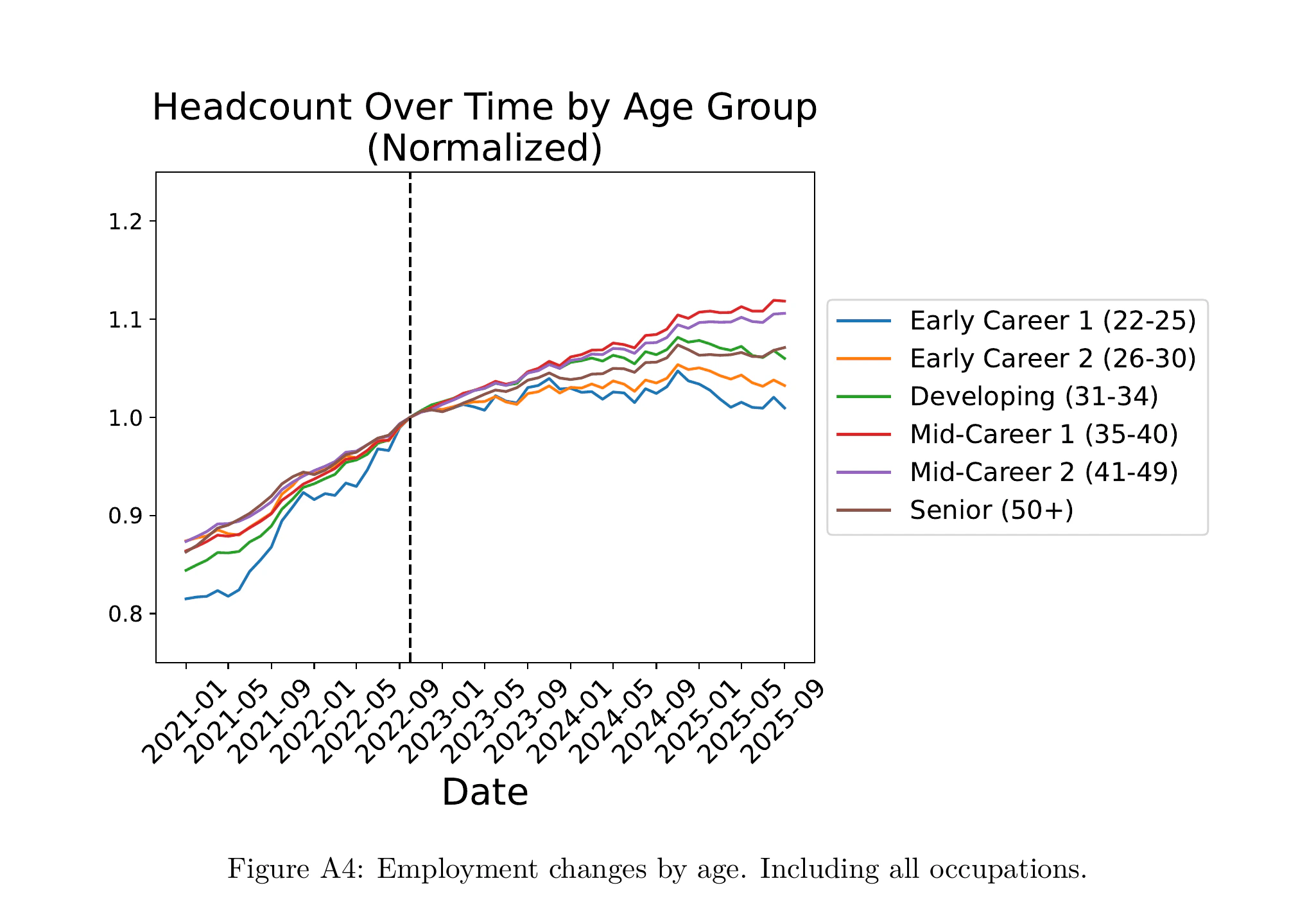
Source: Figure A4 in Canaries in the Coal Mine? Six Facts about the Recent Employment Effects of Artificial Intelligence, Erik Brynjolfsson, Bharat Chandar, and Ruyu Chen, Stanford Digital Economy Lab.
Stable employment can hide a narrowing entrance
The FutureWorks presentation distinguished between employment among current entry-level workers and opportunities for people trying to enter. Those indicators can move differently.
Organizations may retain the junior employees they already have while posting fewer new roles. The current workforce therefore looks stable even as graduates and career changers find fewer openings. By the time the shortage appears in mid-career hiring, several years of development have already been lost.
This matters beyond young graduates. Entry-level roles are also entry points for people changing occupations, returning after caregiving, immigrating, or converting informal experience into a formal career. A thinner pipeline reduces mobility for all of them.
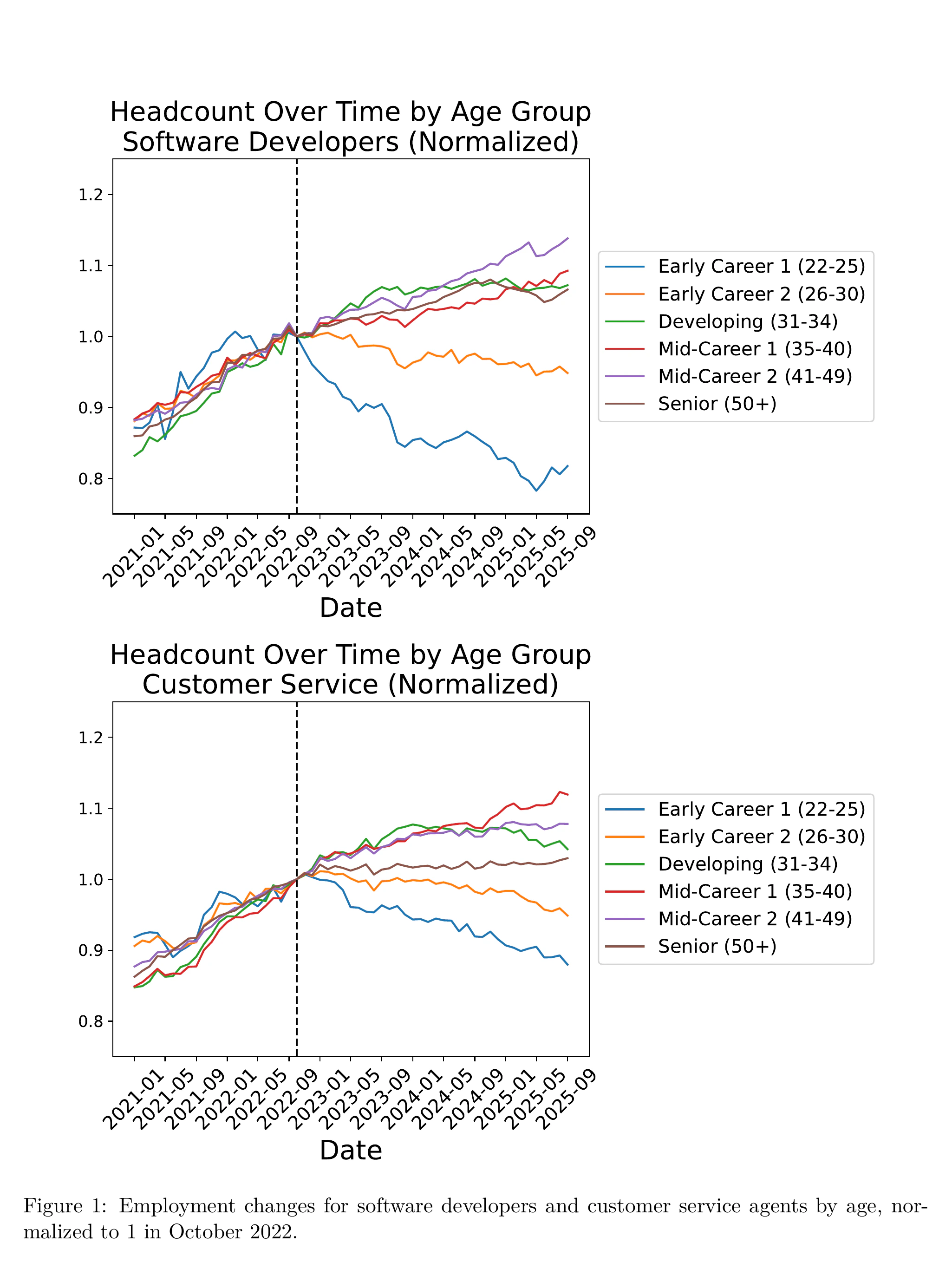
Source: Figure 1 in the same Stanford Digital Economy Lab paper.
AI can accelerate learning, but only with a learning design
Used well, AI can give a junior employee faster feedback, explain unfamiliar concepts, produce a first draft to critique, and make more advanced tools accessible earlier. That can compress parts of the learning curve.
It cannot automatically provide organizational context, accountability, or calibrated judgment. A novice may produce polished work without recognizing a flawed assumption. If a senior colleague only sees the final output, they may not know which parts the junior understands and which parts the system supplied.
Development therefore needs visible reasoning. Ask employees to explain choices, test outputs against source material, compare alternative approaches, and reflect on what the tool missed. Give them real decisions with bounded consequences, not only responsibility for prompting a system.
The manager’s role becomes more important. Learning by doing still works, but the “doing” has to be designed when technology removes the old repetitions.
So what should employers rebuild?
Before automating an entry-level task, identify its developmental function. What did people learn from repetition? Which relationships did the task create? What mistakes were safe enough to make? Which unwritten rules became visible?
Then relocate those opportunities. Create apprenticeships, rotations, supervised client exposure, case reviews, simulations, and progressively larger decisions. Pair AI-assisted production with human debriefs. Evaluate whether a junior employee can recognize a weak output, not only generate a strong-looking one.
Workforce planning should also model the pipeline over several years. A task-level business case may show immediate savings. A talent-level case must include future recruitment costs, succession risk, and the scarcity created when fewer people acquire intermediate experience.
For early-career workers, the most valuable role may be the one that offers access to context and feedback, even if another role offers more sophisticated tools. Ask who will review your work, what decisions you will gradually own, and how people move from junior to trusted contributor.
The entry-level job of the future does not need to preserve every task from the past. It does need to preserve a credible route from knowing little to being trusted with more.

Guy Giguère, creator of the RVEAL framework and cofounder of RVEAL, has four decades of coaching across North America, Europe, and Africa, 100+ talks on labor-market evolution,…
Ready to find career alignment?
Take the assessment and get 3 free coaching sessions with Leo.