
AI Is Swallowing Data Analytics Faster Than Any Other Field. Why Are Companies Still Hiring Analysts?

AI Is Swallowing Data Analytics Faster Than Any Other Field. Why Are Companies Still Hiring Analysts?
The dashboard says churn has dropped 11% in a week, and for about four seconds the analyst at a mid-size insurance firm believed it. Then she didn't. 11% is anything but normal human behavior; it must be a broken join, or a date filter that's incorrectly including a weekend. She had not inspected the data yet. She had only looked at the number and it felt wrong, the way you sense a person's stare. The AI that produced the figure had done everything correctly and arrived at an incorrect conclusion, and the only safeguard between a wrong number and a roomful of executives acting on it was a person who knows, before inspecting, that real churn does not just lurch.
That four-second moment of suspicion is becoming the number one requirement for analyst job postings. According to Indeed's Hiring Lab, nearly 45% of US data and analytics job postings contain AI-related terms as of December 2025. That is roughly ten times the 4.2% average across all postings. No occupation is more saturated in the language of AI than the one whose whole job is to turn data into answers.
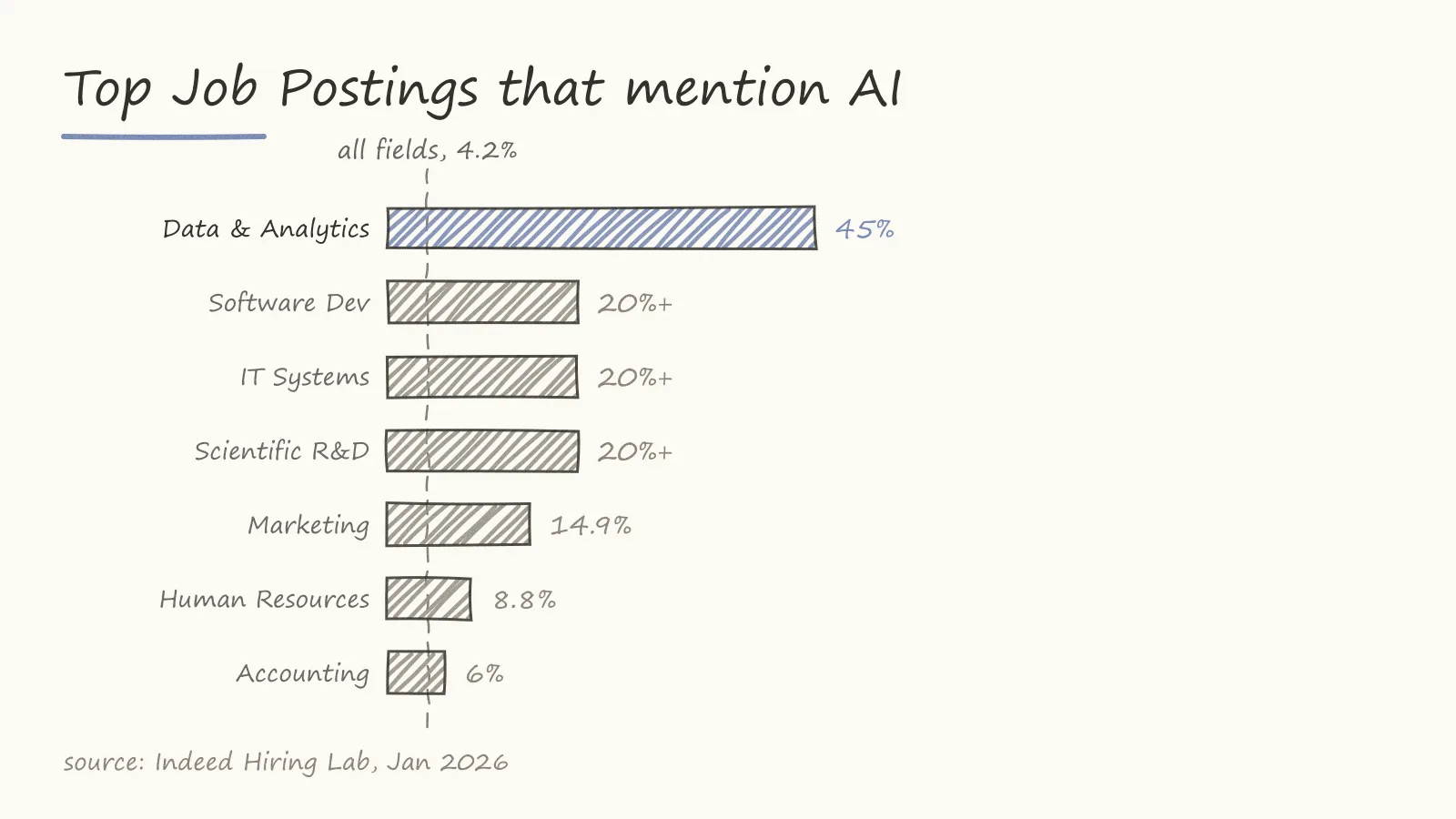
It would be easy to read this as the field automating itself out of existence; the snake eating its own tail. That would be wrong. Every one of those job postings is still a search for a person. The change in job description signals not that AI is replacing data analysts, but rather that companies increasingly need a human who can work alongside AI without being fooled by it.
For two decades, an analyst's day was frontloaded with execution: writing queries, cleaning data, fine-tuning a chart, rebuilding the same report month after month. AI now does most of that. What AI cannot do is the thing the insurance analyst did in her four seconds of doubt: critical thinking. Yes, AI can "think", but it cannot tell that 11% is the wrong kind of number if its context isn't explicit about it. It will return a confident, completely wrong answer and leave it at that, because why question it?
So the work has split, and the part that calls for a human analyst is the part that has always been a little harder to define. There are things like running queries, which AI now does faster than any graduate. And there is critical thinking: which questions should be asked this quarter, and which answer looks wrong before publishing it. The first part is teachable and easily obtainable. The second part is often mistaken for experience, the gift of the senior analyst who glances at a slide and says that can't be right.
The World Economic Forum's Future of Jobs report found that roughly 70% of employers globally rate analytical thinking as essential in the age of AI. Critical thinking is what happens in the seconds before a number is trusted. A graduate who can write flawless code but accepts whatever it returns is in for a challenging time, because it is here where one has to compete, rather than collaborate, with AI: an unwinnable battle in the data and analytics domain.
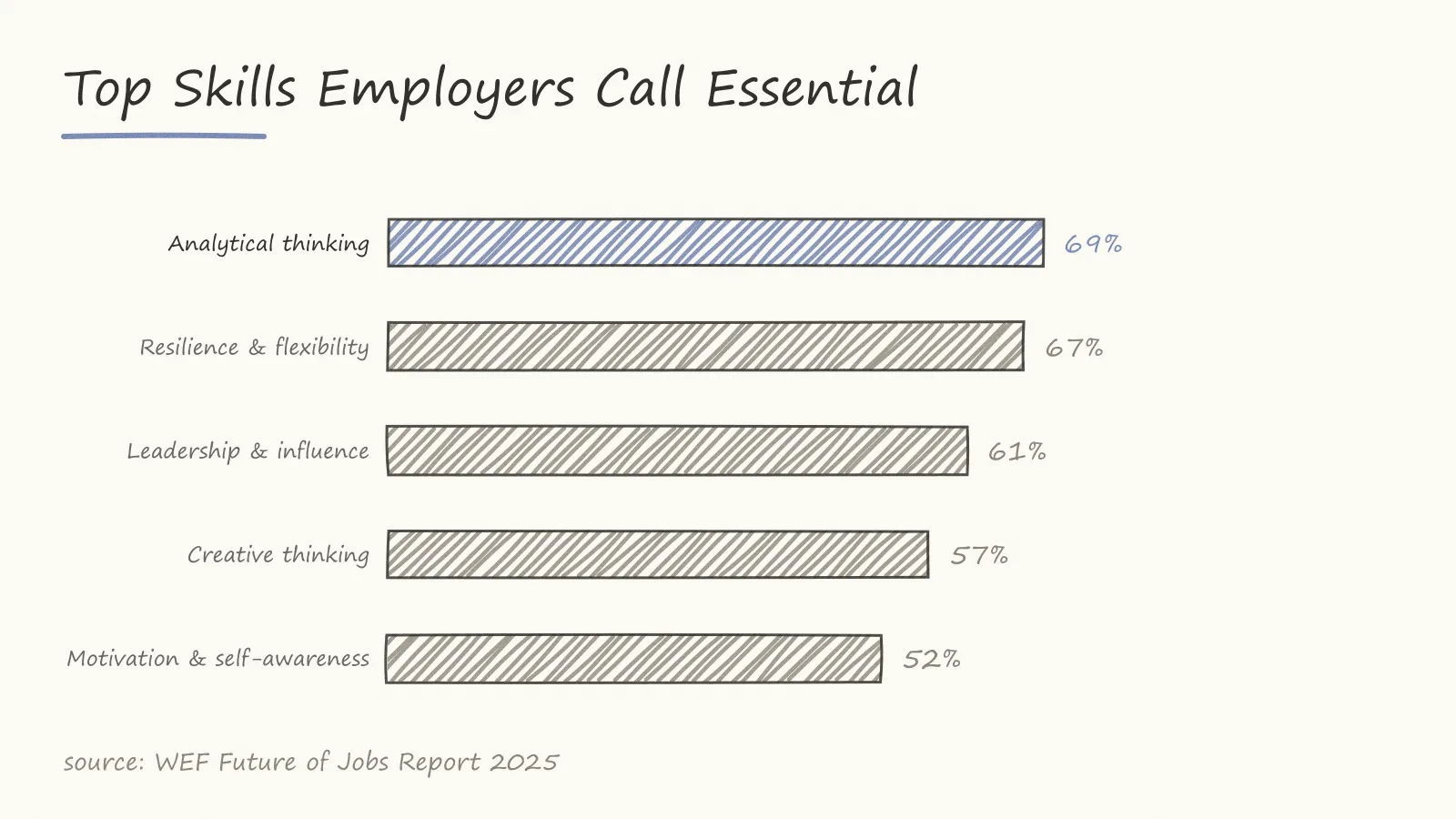
What might be a hard pill to swallow is also what brings hope. For years the field told its newcomers that the credentials and code quality were the key metrics. Reality has changed. Companies still want data analysts, but what they're looking for is closer to a disposition than a skill set, the instinct that something does not add up, the taste for the question no one thought to ask. The field most flooded with AI did not stop needing people. It started, finally, asking them for something that makes them human: the moment of doubt before the answer goes out the door.

Ready to find career alignment?
Take the assessment and get 3 free coaching sessions with Leo.